Our Story

From the first fire
to a bag worthy of the bread.

The kitchen has a long memory. Long before plastic, before factories, before refrigeration — there was fire, and the people who gathered around it to make food worth gathering for. We started Agni to bring a little of that back.

A word that travels

Agni means fire — in every language we know it.

Pronunciation

A-G-N-I  ·  UHG-nee

Two syllables. The "g" is hard — like "gun," not "gem." Across English, French, Hindi, Sanskrit — same word, same meaning. Fire is constant.

In the older traditions some of us grew up around, fire is what cooks food, what cleanses, what gathers people in a circle. The kitchen, in that older sense, was the heart of the home — the one room where what mattered was actually made by hand.

How we got from fire to a plastic bag — and where we go next.

1 / 6
Open hearth fire

Fire was the first kitchen technology.

The earliest evidence of controlled fire stretches back almost a million years. Long before language, before agriculture, before tools — humans knew how to keep a hearth alive. Cooked food made our brains grow. Fire made us us.

We named the brand Agni — Sanskrit for fire — because everything in your kitchen, even now, descends from this moment.

A family kitchen table

The hearth became the centre of the home.

When people stopped wandering, the fire stayed put. The hearth became the room everyone returned to. Stories were told there. Children watched adults cook. Skills got passed on in the small unspoken way they always have — by being in the room while someone older did the thing.

Every recipe in our library is written for a real kitchen — small, busy, sometimes chaotic — not a magazine photo set.

A round artisan sourdough boule

Bread arrived — and changed everything.

Wheat, barley, rye. Stone querns. Sourdough cultures that travelled with families across continents. Bread became the carbohydrate that built civilisations — and the daily ritual that anchored a household.

Our bread bag is sized for a full sourdough boule — 17×13 inches. Most bread bags treat bread like an afterthought. We treat it like the meal it actually is.

Industrial bread in plastic film

Then came factories, supermarkets, plastic.

Mass production gave us more food, faster, cheaper — and quietly replaced linen, ceramic, wood, and beeswax with petroleum-derived film. Bread now arrives in a plastic sleeve. Microplastics have been measured in human blood, lungs, and placentas (Marfella et al., NEJM 2024).

This is the chapter we politely decline to keep writing.

A warm kitchen with bread cooling

A quiet return to honest materials.

Sourdough during the pandemic. Cast iron in the kitchen again. Glass storage instead of cling film. Linen tea towels. Beeswax wraps. None of it is new — it's the kitchen our grandmothers had, rediscovered.

We don't think kitchen tools alone fix any of this. But the small choices compound.

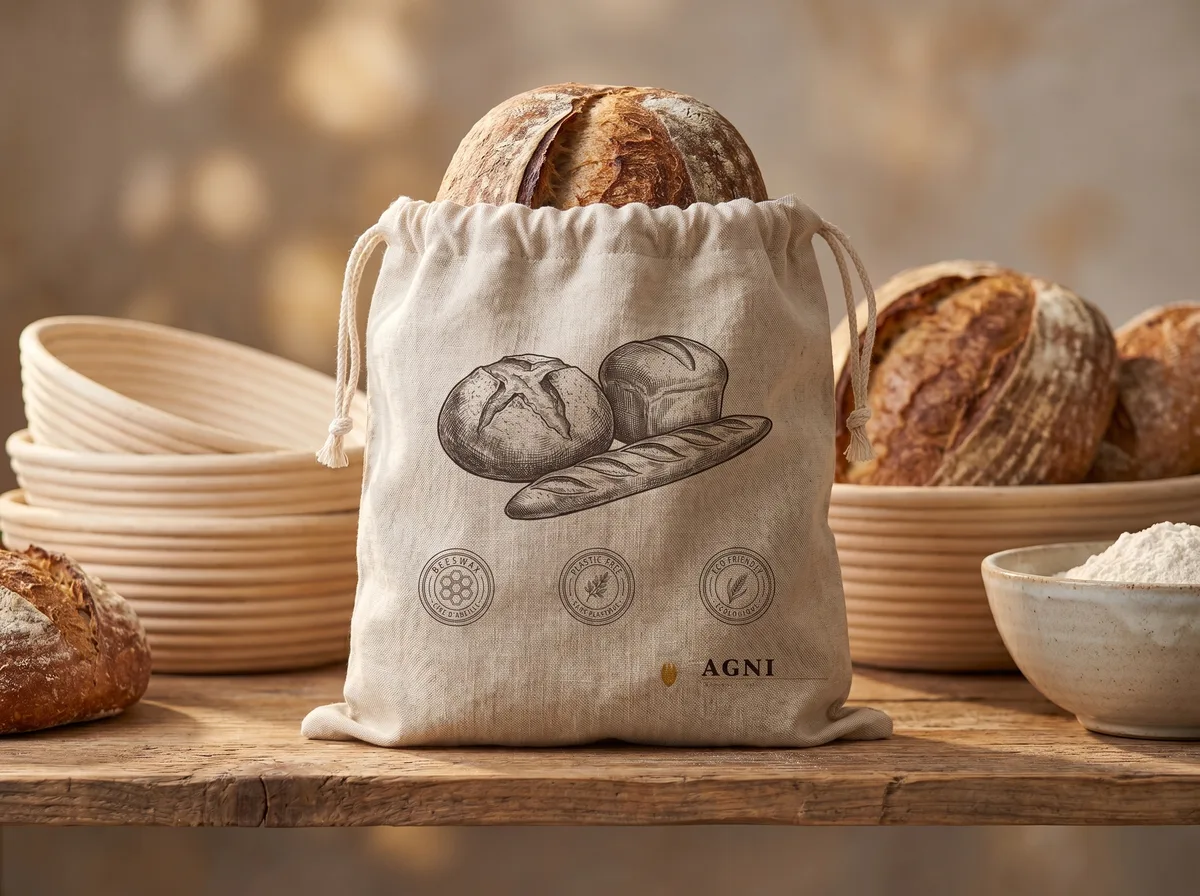
Agni bread bag with a banneton

So we built a bag worthy of the bread.

100% pure linen. Real food-grade beeswax. 17×13 inches — sized for a full sourdough boule. Tested through 50+ wash cycles. Designed in Toronto, assembled in Canada.

Canadian-led. Owned and operated by the women who make the decisions. When you write to [email protected], the reply comes from one of us.

Who we are, practically

A small collective. No unicorn ambitions.

Agni is a Canadian-led collective. We are women in our 30s and 40s based in Ontario, with collaborators across Canada and material partners in India and southeast Asia (where the linen, beeswax, and rattan we use are produced by people we have met and whose work we trust).

We do not have venture capital. We are not building a unicorn. We're building something we want to use ourselves and that we hope you will use too. The brand is owned and operated by the women who make the decisions about it.

Read a recipe. Bake a loaf. Subscribe if you'd like one thoughtful email a week. If a beeswax linen bread bag belongs in your kitchen, we'd be honoured to send you one when we launch on Amazon Canada this summer.

— The Agni collective

Sources cited in the timeline

  • Wrangham R. Catching Fire: How Cooking Made Us Human. Basic Books, 2009.
  • Lane MM, et al. Ultra-processed food exposure and adverse health outcomes: umbrella review of epidemiological meta-analyses. BMJ, 2024;384:e077310.
  • Marfella R, et al. Microplastics and Nanoplastics in Atheromas and Cardiovascular Events. New England Journal of Medicine, 2024;390:900–910.
  • GBD 2017 Diet Collaborators. Health effects of dietary risks in 195 countries, 1990–2017. The Lancet, 2019.

Recipe of the week

One thoughtful email,
every Thursday morning.

A new recipe, the climate notes that go with it, and a paragraph of context. No drip sequences. No promotions. Unsubscribe one click.